



How To Choose The Right Commercial Gym Equipment For Your Fitness Facility
How to Choose the Right Commercial Gym Equipment for Your Fitness Facility
Purchasing equipment for a commercial gym isn't the same as stocking a home garage. You're making a capital investment that needs to survive years of heavy use, generate member retention, and justify your floor plan's revenue per square foot. If you get the mix wrong, you'll either waste space on machines nobody uses or create bottleneck lines at peak hours.
Here's a practical framework for making that decision with confidence.
1. Map Your Floor Space Before You Browse Catalogs
Most facility owners start with equipment they like, then try to fit them into the space. That's backwards and it leads to cramped walkways, awkward transitions between zones, and machines that interfere with each other's range of motion.
Measure your total training floor. Then map out distinct zones: cardio, strength, functional training, free weights, and stretching. Each zone needs its own clearance buffer. Also consider traffic flow—members shouldn't have to cross a free-squat zone to reach the dumbbell rack.
Someone with a large, open hall should look at a dedicated multi-station trainer like the 16 Multi Station (LY16 PRO) or its L-shaped variant. These units combine multiple training stations into one footprint, which is perfect for maximizing equipment density without sacrificing member comfort. At 7740×6850×2440 mm, the straight-line version gives you a complete circuit for multiple users at once. The L-shaped layout, at 10190×6240×2440 mm, is better if you need to wrap around a column or fill a corner more efficiently.
For a smaller or mid-sized facility, consider whether a full multi-station is overkill. Sometimes the money is better spent on individual plate-loaded machines and a solid functional training zone.
2. Match Equipment to Demand But Not to a Fitness Trend
TikTok trends come and go, but your equipment purchase is a long-term commitment. A boutique spin studio can justify a fleet of high-end, commercial-grade indoor cycles. A general gym needs a balanced mix that serves experienced lifters, casual cardio-goers, and everyone in between.
Look at your local market demographics. Are you in a corporate district with lunch-hour traffic? That means high turnover on cardio equipment. In a residential area with family memberships, you need more machines that accommodate varying skill levels and safer movements.
If you're building a cardio zone, the Commercial Intelligent Upright Bike (MH5500) is a solid choice for members who prefer an aggressive riding position. It has magnetic resistance and heart-rate monitoring, but what really drives retention is the connected experience—coaching, virtual routes, and multiplayer options. For an older demographic or members with lower back issues, the Commercial Intelligent Recumbent Bike (MH5600) offers the same tech features with a more relaxed, low-impact seating position.
And if you're aiming to add functional, high-intensity cardio, don't overlook a Non-motorized Treadmill (MH6800). Self-powered treadmills let users control the pace, which is great for intervals and programming. Plus, they reduce your electrical load and maintenance costs compared to motorized units.
3. evalsuate Build Quality and Weight Stacks Like a Pro
Commercial-grade equipment is a lifespan calculation. A cheap consumer piece might fail in six months under gym traffic. Look for welded steel frames, heavy-gauge materials, and weight stacks of at least 80 kg. Heavier stacks mean the machine is built to withstand more abuse and appeal to stronger members.
Don't be shy about pulling up the spec sheet and asking about net weight. If a lat pulldown model seems too light for its size, that's a red flag.
Take the MTMS-012 Lat Pull Down
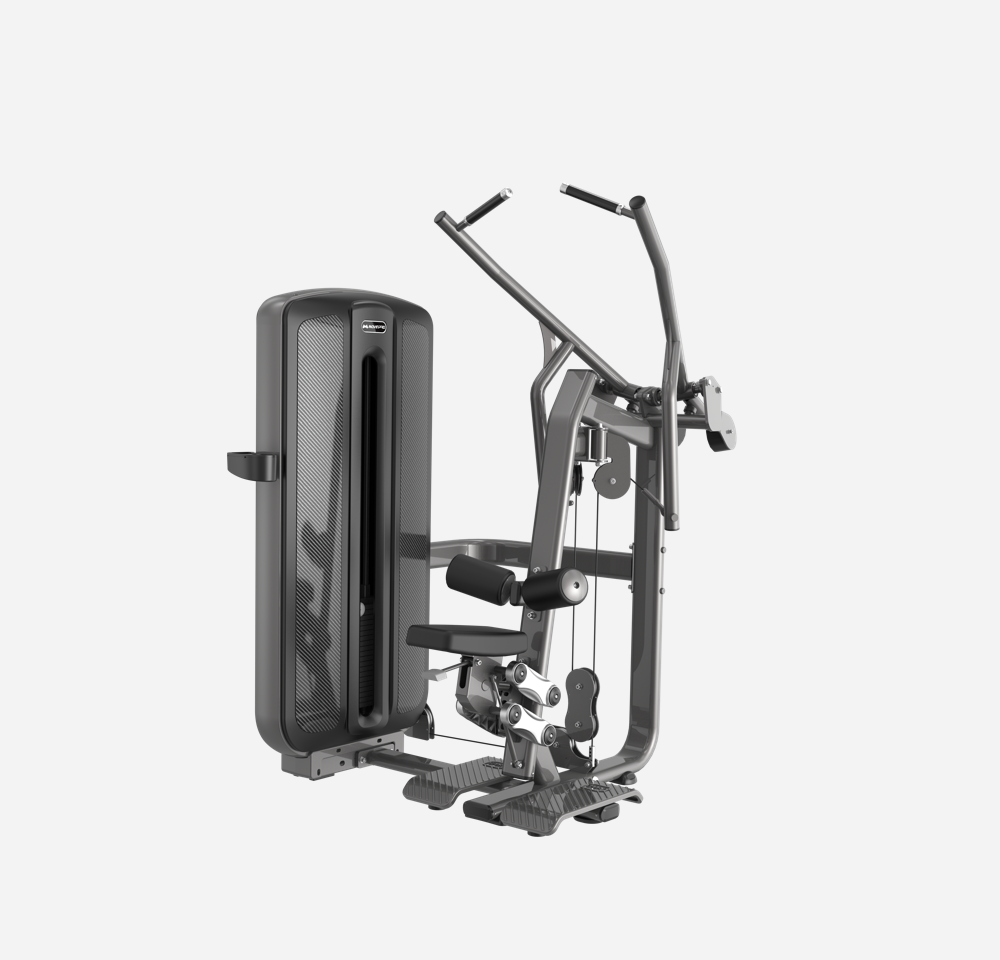


When you're building a lower-body line, the T8-014 Leg Extension is the kind of single-joint piece that's unglamorous but essential, working the rectus femoris, vastus lateralis, and vastus medialis—with an 80 kg weight stack and a 150 kg maximum user weight.
4.Prioritize Compound and Core Movements
Beginners and experts both need a solid foundation. Compound movements like the squat, bench press, and deadlift should have dedicated space. Holding those movements builds the largest percentage of your membership's functional strength.
But even the most basic pull-up station or squat rack needs to be set up for safety and longevity. Consider a Functional Training GYM Layout Set. These aren't just a single rack—they can integrate free squat racks, pull-up bars, TRX mounts, climbing stations, sandbag hooks, and rope pulls into a single footprint. With dimensions ranging from a compact 1250×1770×2415 mm up to the massive 20475×8460×2960 mm layout, you can scale it to your available square footage. Before you order, note that these layouts don't include the Olympic bars or barbells in their net weight—you'll need to budget for those separately.
5. Don't Neglect the Isolation and Mobility Machines
You might think plate-loaded machines and floor space are enough, but your members will expect cable machines and isolation pieces for targeting smaller muscle groups. Having a few key machines works for both prehab work and serious bodybuilders.
For example, the Standing Abductor (METS5-17) works the glutes and hip abductors. It's a compact machine at 1900×1560×1540 mm and fits perfectly in the corner of a strength zone. The Rotary Torso (MCL-011) works the rectus abdominis, obliques, and lower back, which is highly valuable for athletes and desk workers alike. If you've got space for another single-joint piece, the T8-014 Leg Extension is a classic quad builder, while the XMDM-002 Pec Fly targets the chest, and the GTS-017 Calf Extension gives members the dedicated calf work they demand.
All of the above will be rated with a max user weight of around 150 kg. That's the baseline you should be looking for in a commercial environment.
6. Consider Smart Technology and Member Experience
You can't ignore the connected fitness trend. Not every gym needs a full suite of app-connected equipment, but if you're building new, consider adding some tech-enabled pieces to your mix. They're a differentiator and generate valuable workout data.
An intelligent bike like the MH5500 or MH5600 bridges the gap between the analog gym floor and a digital fitness experience. These machines feature 430W max motor power, 1000 RPM, magnetic resistance, and self-powering capabilities. They're basically a gym in a box for cardio programming.
Remember, the goal isn't to be the techiest gym in town—it's to be the most effective one.
Making the Final Call
Start by sketching out a layout that meets your membership goals. Have a budget in mind, but more importantly, have a vision for what type of training you want to promote. Is it athletic performance? General fitness? Senior-friendly mobility?
Buy the best-quality equipment you can afford, and avoid the temptation of cheap imports that just look good in a catalog. A weaker bench or a flimsy rack will cost you money in repairs and member trust in a few years.
If you're planning the full renovation of a gym, look at a turnkey solution like the 16 Multi Station (LY16 PRO). These multi-user circuits are economical in terms of square footage and they keep your floor organized.
Take your time, demo the equipment if you can, and don't rush. Just remember—every machine you add is a member's long-term commitment to their own fitness. Give them the tools that can handle the load. In addition, you are warmly welcome to contact MBH commercial fitness equipment manufacturer for your right choice.
