



Commercial Gym Equipment Checklist And Layout Guide | How To Build A Complete Commercial Gym
Honestly, commercial gym layout mistakes cost you far more than gym equipment mistakes ever will. You can swap a leg extension in an afternoon — a truck shows up, two guys, done. Try moving a load-bearing wall. Try re-running 400A service because cardio ended up in the wrong zone. I've watched a 12,000 sq ft build in Denver eat $90K in change orders over exactly that: racks in, slab poured, and the cardio deck didn't have the power it needed. Nobody sits down and plans to make that call. It just happens when the drawing never got pressure-tested by someone who's actually run a floor.
So here's what I'd actually walk you through: how the zones should flow, which equipment earns its square footage, and where the traps are that quietly bleed your ROI. Skip the flow part and you'll pay for it later. Every time.
Honestly? Members judge a gym on one thing in the first five minutes: can I do the thing I came here to do? Before you get excited about a rig or a turf strip, make sure the floor actually covers the basics. I've walked into beautiful facilities — exposed ductwork, great lighting, the works — where you couldn't find a single adjustable bench. That's a retention problem you don't fix with a juice bar. Here's my minimum bar: presses, a leg press, a cable crossover or two, a functional trainer, dumbbells that go heavy enough for your strongest member, and enough cardio that nobody's queuing at 6pm. Get that right first. Everything after it is decoration.
Start With Commercial Gym Layout Zones But Not a Shopping List
Lower body is where you'll spend the most money and get the least credit. Nobody walks in saying "ooh, a leg press." But skip it and watch your squat rack queue turn into a fight. Here's what we put on most mid-size floors: a 45-degree leg press, a hamstring curl — seated or lying, your call — a leg extension, and something for glutes. Are all four essential? No. Can you get away with three? Sure, if your membership skews young and squat-happy. Be careful with that hamstring work, though. Your glutes and hamstrings are what keep a 45-year-old's knees and lower back out of trouble, and that 45-year-old is the member who pays your rent for the next decade. I've seen gyms drop the hamstring curl to save eight grand and then spend more than that in the following two years on churn. Nobody ever attributes the churn to the missing machine. That's the problem.
Upper body is where I'd spend the least — and think the hardest. One good chest press, a lat pulldown, and a seated row covers 90% of what your members actually do up there. I've seen too many operators buy five separate single-station machines — pec deck, lat pulldown, seated row, shoulder press, biceps — and end up with a corner nobody uses because everyone's at
- Strength circuit — 1.5–2.5 m between machines for safe loading and member traffic
- Free weights — minimum 3 m clearance around racks and platforms
- Functional zone — open floor, mirrors on at least two walls, rig anchoring points
- Cardio — line up rows facing windows or screens; keep 0.9 m between units
Want a shortcut? Pre-configured multi-station training systems like the XPH-201 (10,490×2,455×2,435 mm, 1,045 kg) bundle free squat racks, Smith machines, pull-up bars, TRX anchors, dip stations, and storage into one footprint. That's four squat racks, eight pull-up stations, thirteen TRX points — enough to anchor an entire functional zone without piecing it together.
Strength Equipment | Hit Every Major Muscle Group
Members judge a gym by whether they can train what they came for. Cover these categories at minimum:
Lower Body
Leg extension and adductor/abductor machines see the heaviest repeat use in most facilities. The MEL-016 Standing Leg Extension
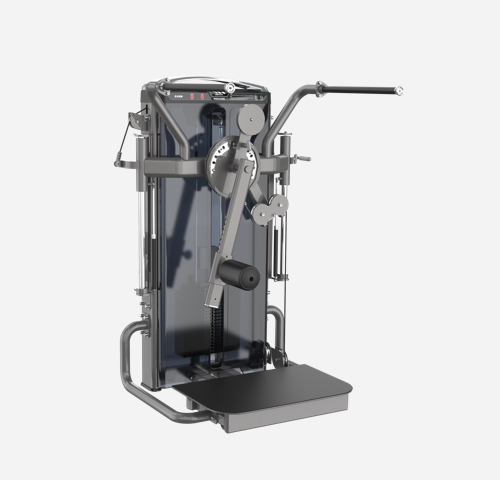
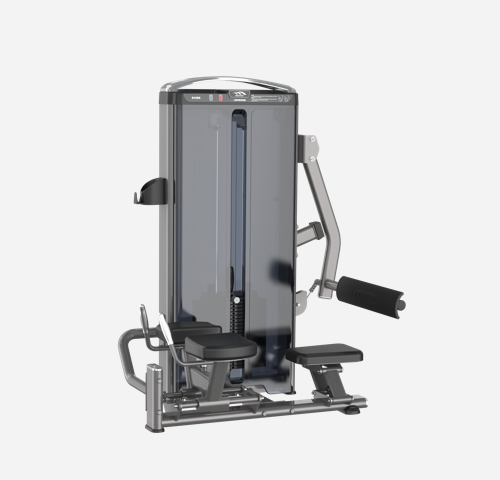
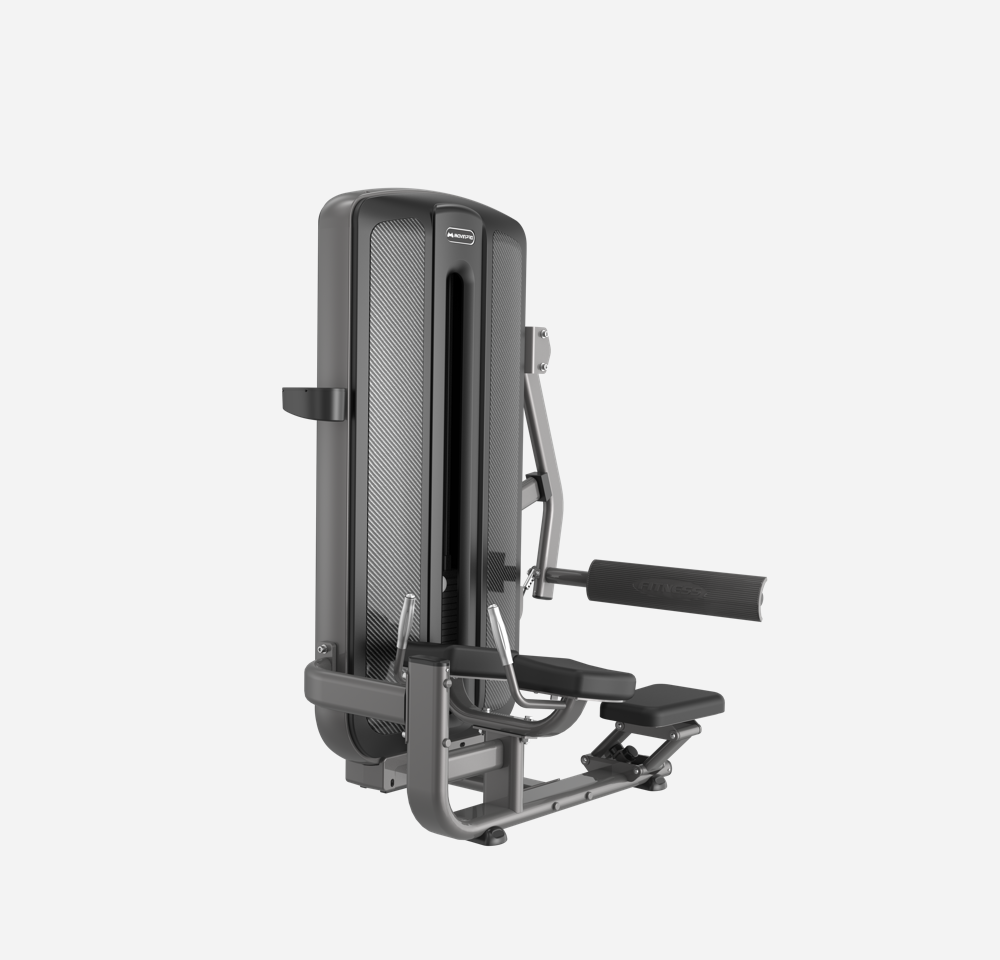
For glutes and hips, the METTA5-17 Standing Abductor (1,900×1,560×1,540 mm, 210 kg) and AMV-43 Standing Outer Thigh Abductor are plate-loaded workhorses. Pair with the XVS-43 Standing Outer Thigh Adductor (1,520×1,000×1,430 mm, 113 kg) and XVS-37 for inner thigh — the XVS-37 hits the iliotibial band, gluteus maximus, biceps femoris, and tensor fasciae latae. Round out with the XVS-26 Sitting Outer Thigh Abductor (1,880×650×1,050 mm, 115 kg) for gluteus medius work.
Upper Body
The XVS-32 ISO-Lateral Standing Lateral Raise (2,230×1,410×1,760 mm, 168.5 kg) is a solid pick for deltoid isolation. For pressing and pulling, the XVS-31 Standing Chest Trainer (1,500×1,400×1,300 mm, 125 kg) covers pecs, lats, biceps, delts, and triceps in a single frame.
Cardio | Don't Skimp on the Experience
Cardio is where members spend the most time — and where comfort drives retention. The MH5600 Commercial Intelligent Recumbent Bike (1,900×630×1,480 mm, 94 kg net 139 kg gross) brings a 430W max motor, 1,000 RPM capability, magnetic resistance, self-powered operation, and hand-grip heart-rate monitoring. Max user weight is 200 kg, which matters for inclusive programming.
Recumbent bikes serve older members and rehab clients especially well. Give them a dedicated row away from the HIIT noise.
What to Buy First vs. Later
Phase your spend:
- Phase 1 (opening day): functional rig or multi-station system, 6–8 strength machines covering push/pull/legs, 4–6 cardio units
- Phase 2 (months 3–6): expand specialty machines based on usage data — usually adductors, glute isolation, and second-row cardio
- Phase 3 (year 2): premium or Smart Strength upgrades for retention and premium tier pricing
Track usage per machine for the first 90 days. Duplicate the top three and cut the bottom two. That data beats any showroom opinion.
Final Checks Before You Sign
Confirm ceiling height (3 m minimum for overhead rigs), floor loading (strength zones need 200+ kg/m² capacity), and power supply for cardio. Verify plate-loaded units ship with hardware but not Olympic bars — budget separately for those.
Build the zones right, phase the equipment, and let usage data steer expansion. That beats guessing every time.
For more information about any model of commercial gym equipment, please feel free to contact our engineer.
